
■ The project has been subsidised by the Diputació de València through the ‘Impulsem Turisme 2024’ programme
■ La Ribera Aumentada integrates 21 3D elements, from towers and chapels to bridges and walls, into a pocket map
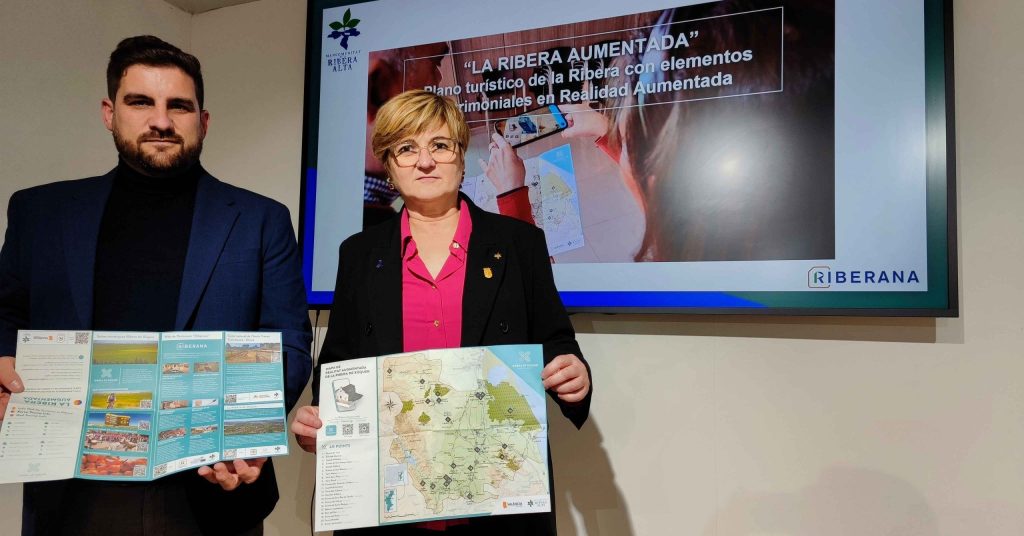
The Mancomunitat de la Ribera Alta and the Consorci de la Ribera have presented a major new development in the field of tourism promoted by regional authorities at FITUR. This is the ‘La Ribera Aumentada’ project, a pocket tourist map that integrates 21 elements of the region’s cultural heritage into augmented reality.
The president of the Mancomunitat de la Ribera Alta, Paqui Momparler, presented this new development at FITUR: ‘We have created a modern and up-to-date tourism product to make La Ribera a benchmark in the promotion of smart tourism, taking advantage of innovative augmented reality and mobile application technologies and integrating various 3D projects that the Mancomunitat de la Ribera Alta has carried out through its Heritage Department in recent years.’
‘La Ribera Augmentada’ has been made possible thanks to a grant from the Diputació de València and the Impulsem Turisme 2024 programme, with a total budget of €17,714.40. It has an app and a series of fold-out pocket maps, with 21 augmented reality models to accompany visitors on their tour of La Ribera.
Among the elements it includes are castles and towers, chapels, bridges and walls: the Castell de Alfarb, the Torre dels Coloms del Monestir de la Murta, the Walls of Alzira, the tower of Antella, the Towers of Plaça and Musa in Benifaió, the chapel of Sant Roc de Ternils in Carcaixent, the Napoleonic Battery and the Pont del Rei in Gavarda, the castle of Aledua in Llombai, the castle of Montroi, the castle of Turís, the Torre Racef in Almussafes, the Hermitage of Santa Bàrbara in Alberic, the Hermitage of El Rosario in Beneixida, the Hermitage of Sant Bernat in Carlet, the Calvari in l’Énova, the Hermitage of Sant Antoni in Llombai, the Hermitage of El Calvari in Sumacàrcer, the Benissants de la Pedra in Sueca and a virtual 3D model of Corbera Castle.
To make the project a reality, the digitisation work carried out by Riberana over the last five years has been used, in which several of these elements have been digitised in 3D thanks to various programmes run by Turisme Comunitat Valenciana and its own funds. An app (La Ribera Augmentada) and maps in three languages have been created and will be distributed by town councils, tourist offices, tourist agents, accommodation providers and restaurants that wish to do so.
Víctor Rey, head of the Heritage Department of the Mancomunitat de la Ribera Alta, highlighted that ‘this project brings together in a single space, which is easy to share and transport, the work of disseminating and digitally preserving the rich heritage of La Ribera, through its oldest and most unique archaeological heritage’. He also pointed out that ‘this element includes texts and audio descriptions in three languages: Spanish, Valencian and English, so that as many people as possible can access and enjoy the heritage of the Ribera’.


