
- Over the 28 months of the project, 172,210 m² of invasive reed has been removed, exceeding the 142,012 m² initially planned.
- The “Canya a la canya” project leaves a 75 km green corridor in La Ribera.
- The project is supported by the Fundación Biodiversidad of the Ministerio para la Transición Ecológica y el Reto Demográfico (MITECO) as part of the Recovery, Transformation and Resilience Plan (PRTR), funded by the European Union – NextGenerationEU.
The ‘Canya a la canya’ project has come to an end, having significantly exceeded the objectives set at the outset. Launched in November 2023, it was originally due to conclude in December 2025, but was extended until March 2026 as a result of the effects of the 2024 DANA, which disrupted some of the activities. The project has been implemented by the Consorci de la Ribera, comprising the Ribera Alta and Ribera Baixa associations of municipalities, and the Fundació Limne.
This initiative was launched with the aim of mitigating the risk and impact of flooding by creating a 75-kilometre green corridor along the River Xúquer through a series of objectives: the removal of obstructions; the creation of flood retention areas; the restoration of the riverine environment; the improvement of infrastructure; and the stabilisation of the riverbanks. Work has been carried out in 13 municipalities in the Ribera Alta and Ribera Baixa regions: Sumacàrcer, Antella, Gavarda, Alberic, Benimuslem, Alzira, Algemesí, Albalat de la Ribera, Polinyà de Xúquer, Sueca, Riola, Fortaleny and Cullera. The objectives have been successfully achieved and have far exceeded the initial forecast.
The main action – the removal of Arundo donax – has cleared a total of 172,210 m² of this invasive alien species from the riverbanks. This represents 121.26% of the figure estimated prior to the project, which was 142,012 m². In addition, 63,800 m² of geotextile that was damaged during the 2024 DANA had to be replaced.
The objectives for the management and control of native vegetation have also been exceeded, with the removal of 2,021 m² of reed beds and the management of 63 trees in poor condition and 2,120 m² of shrubs. Furthermore, more than 100,000 native riparian forest species have been planted in the cleared area.
In addition to removing the geotextile used during the “Canya a la canya” project to prevent the reeds from regrowing, more than 30,000 m² of abandoned geotextile from previous projects has been removed in the municipalities of Gavarda, Algemesí and Albalat de la Ribera. This figure once again exceeds the target, which was set at less than 6,000 m².
As for other technical measures, a key initiative has been the conversion of 27,771 m² of agricultural land into riverine habitat in the municipalities of Alberic, Alzira, Polinyà de Xúquer, Sueca and Cullera. In the first and last of these towns, this work has been made possible thanks to stewardship agreements with private landowners. Finally, 1,651 m² of bank stabilisation and backfilling has been carried out in Alzira, using the Krainer wall technique, and in Cullera, where a breakwater wall has been constructed.
The project has also carried out cross-cutting governance and participation initiatives, such as the creation of the Xúquer River Advisory Council, involving the Consorci de la Ribera, the Fundació Limne and local councils, as well as private individuals and organisations. Furthermore, 15 environmental information panels have been installed at various points along the river, and over 400 environmental education activities have been carried out, involving more than 8,000 people. These have given the public the opportunity to take part in meetings, community planting days, school workshops, conferences and interpretive trails.
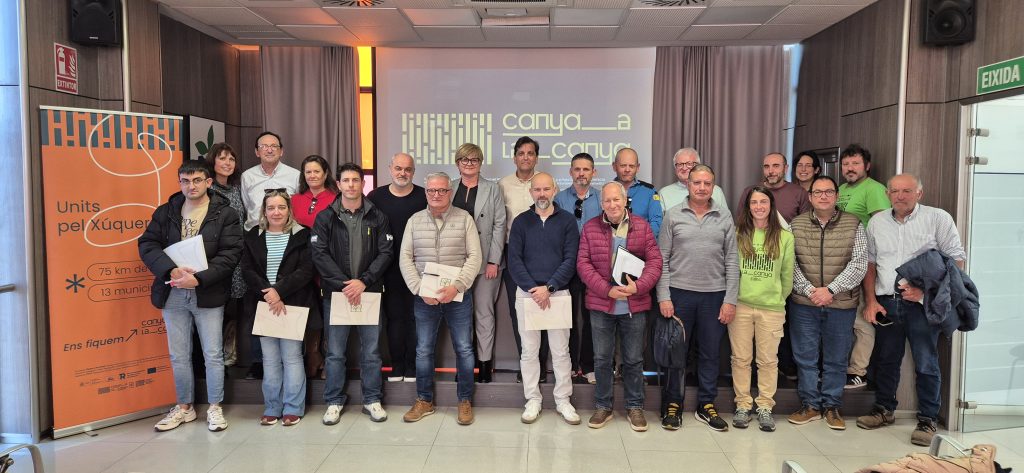
To round things off, “Canya a la canya” opened its doors to local councils and the public for a closing event to mark the end of the project, during which an assessment was made of the actions carried out – which can be considered a success, as they met and exceeded expectations. Furthermore, it has prompted reflection on the need to build on the actions carried out with new initiatives that help to continue improving the environment of the River Xúquer and preventing the risk of flooding.
The “Canya a la canya” project is supported by the Fundación Biodiversidad of the Ministerio para la Transición Ecológica y el Reto Demográfico (MITECO) as part of the Recovery, Transformation and Resilience Plan (PRTR), funded by the European Union – NextGenerationEU.


