
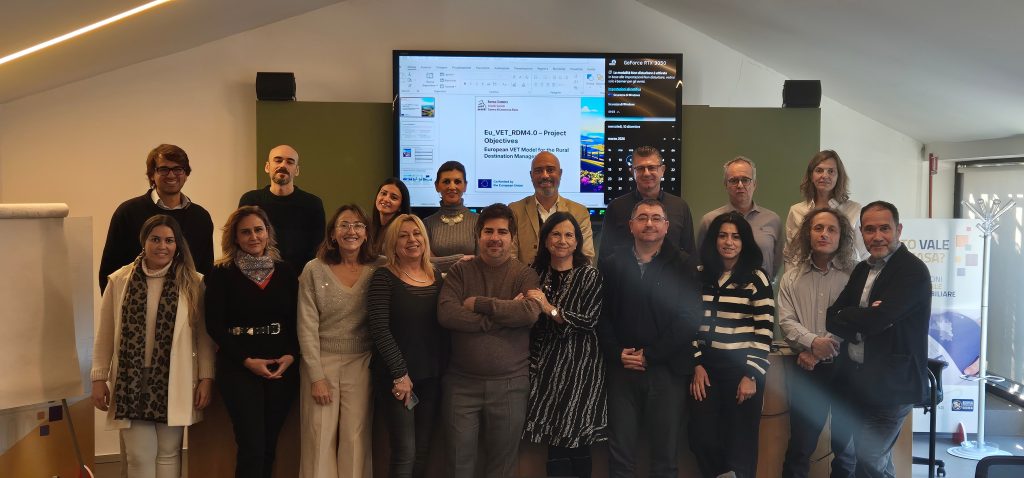
The Mancomunitat de la Ribera Alta participated in the kick-off meeting of the European Eu_VET_RDM4.0 (European VET Model for the Rural Destination Manager 4.0) project. The regional body, together with seven other institutions from across the continent, is part of this European Union ERASMUS+ programme initiative, which focuses on training and rural tourism.
The project was created with the aim of increasing Europe’s competitiveness as a tourist destination by creating a common path for the professionalisation of rural destination management based on the innovative integration of digital and sustainable strategies, methods and tools. It also aims to improve the skills of rural businesses at a local and global level and to promote the adoption of sustainable and participatory management processes and the enhancement of the European Union’s heritage.
Running from November 2025 to April 2028, i.e. for a period of 30 months, Eu_VET_RDM4.0 is based on international cooperation. It incorporates processes and capacity-building pathways from the Vocational Training 4.0 programme, a model based on new technologies, and promotes an innovative digital environment for training in rural destination management.
The project coordinator is the Confederazione Nazionale dell’Artigianato e della Piccola e Media Impresa di Roma, from Italy. Two partners from Greece, the Region of Epirus and the University of Ioannina, and two from Bulgaria, the Bulgaria Training association in Sofia and the Local Action Group of Pomorie, are also participating, as well as the University of Niš in Serbia. On the Spanish side, in addition to the Mancomunitat de la Ribera Alta, there is the Instituto de Técnicas Educativas (ITE Network) in Las Rozas, Madrid.
During the kick-off meeting, each partner gave a presentation on their institution and the project implementation methodology, objectives and activities to be carried out were established. A debate was opened between the entities and the work corresponding to each one was distributed.
This initiative is expected to improve VET (Vocational Education and Training) organisations. Specifically, it is expected to increase the capacity to design innovative training systems in the tourism sector and digital and social skills focused on rural networks and inland areas.


