
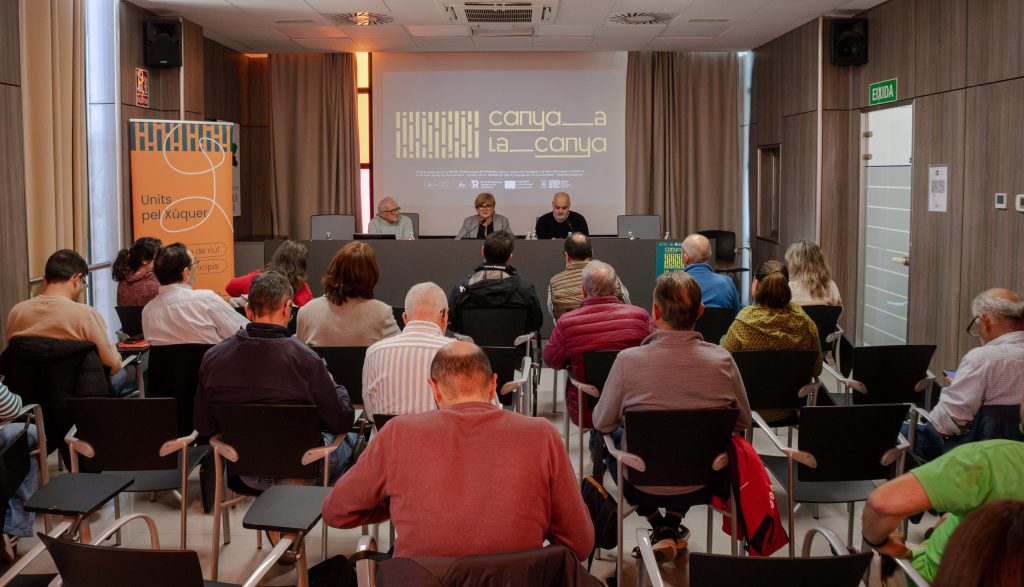
- A comprehensive legal report, drawn up as part of the “Canya a la Canya” project, defines local powers to turn river restoration into stable public policy.
- The document has been presented to the newly established Advisory Council as the key tool for coordinating the management of urban watercourses, the fight against invasive species and sustainable public use.
- The project is supported by the Fundación Biodiversidad of the Ministerio para la Transición Ecológica y el Reto Demográfico (MITECO) as part of the Recovery, Transformation and Resilience Plan (PRTR), funded by the European Union – NextGenerationEU.
Following the recent establishment of the Advisory Council for the promotion and conservation of river ecosystems, the Consorci de la Ribera, comprising the Ribera Alta and Ribera Baixa associations of municipalities, and the Fundació Limne have presented a pioneering legal report that clarifies and strengthens the role of local councils in the protection of the River Xúquer.
The report, drafted by experts in administrative and environmental law under the umbrella of the “Canya a la Canya” project, has a clear objective: to ensure that restoration actions are not isolated interventions, but are consolidated as part of the routine and planned management of each municipality.
A legal framework for local councils
Historically, the complexity of responsibilities within the public water domain has created uncertainty in local management. The new report presented by the Consorci and Limne clears up these doubts, emphasising that the Framework Law on Local Government and the recent reforms to the Public Water Domain Regulations fully empower local councils to take action on their urban sections. “We want every local council to have a clear roadmap, backed by legal certainty, to maintain what has been restored”, says Toni Barea Olmos, president of the Consorci de La Ribera.
The document highlights several key points, such as the possibility for local councils to implement multi-year maintenance programmes for selective cleaning and the control of invasive species (such as the well-known invasive reed Arundo donax) without constant authorisations, provided they have a favourable report from the Júcar River Basin Authority; the need to integrate the river into the municipalities’ General Urban Development Plans (PGOU), promoting Green Urban Planning that protects ecological corridors from human pressure and the urbanisation of floodplains; and the identification of the Municipal Natural Area as the ideal framework in the Valencian Community for local councils to lead the active conservation of their natural heritage.
Shared governance and stewardship of the territory
In its legal report, the Consorci de la Ribera y Limne places particular emphasis on the fact that the health of the Xúquer depends on cooperative governance. The Consorci reaffirms its role as the ideal vehicle for coordinating shared services, optimising costs and providing technical and legal assistance to local councils.
Furthermore, the report advocates for public-social collaboration, positioning the stewardship of the territory as a strategic approach. This model enables civil society organisations and local councils to sign agreements for ecological monitoring and public awareness-raising, ensuring that the local community feels jointly responsible for the care of their river.
About the Canya a la Canya project
The Canya a la Canya project, running from 2022 to 2026, has focused on creating a major green corridor between Sumacàrcer and Cullera, centred on the restoration of native biodiversity and the reduction of flood risk. The initiative has been supported by the Fundación Biodiversidad of the Ministerio para la Transición Ecológica y el Reto Demográfico (MITECO), as part of the Recovery, Transformation and Resilience Plan, funded by the European Union – NextGenerationEU.


